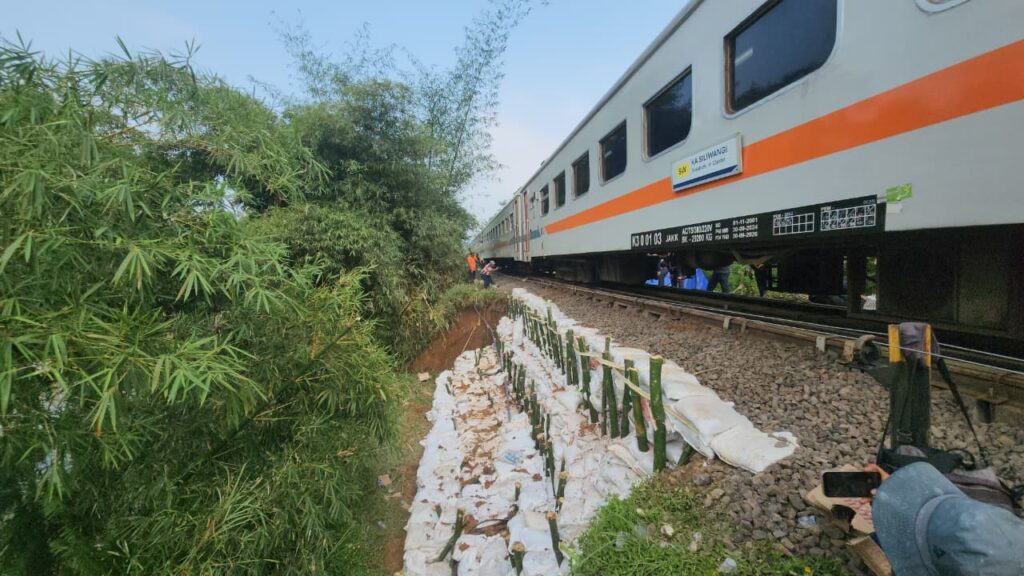
PT Kereta Api Indonesia (Persero) Operational Area 2 Bandung ensures that the handling of infrastructure disruptions in the form of scratches on the train track on the road between Cibeber Station and Lampegan Station has been completed.
The route, which was previously impassable due to a rockfall at Km 74+9/0, has now been declared safe for trains to pass at limited speeds and will gradually return to normal. The handling process was successfully completed on Monday, April 20 2026 at 12.30 WIB.
KAI Daop 2 Bandung Public Relations Manager, Kuswardojo, said that the success of this handling was the result of the fast and collaborative work of all officers in the field who worked non-stop to restore train travel operations.
“KAI ensures that the route on the stretch of road between Cibeber Station and Lampegan Station can be passed again by trains starting at 12.30 WIB while still prioritizing travel safety by implementing limited speeds,” said Kuswardojo.
The first train to pass through this location was KA Siliwangi (343) with the Cipatat – Sukabumi connection, which passed at 15.35 WIB in safe and smooth conditions with guarding by officers and limited speed.
With the passage of the first train, the operations of the Siliwangi train on the Cipatat – Sukabumi route are now gradually returning to normal and can serve the community as before.
Apart from that, during the disruption period, it was recorded that up to Monday afternoon a total of 727 Siliwangi train customers had their trips cancelled. The cancellation is the result of the non-operation of 4 Siliwangi train trips.
The details of the canceled trips are that on Sunday, April 19 2026, 1 Siliwangi train trip (345) was cancelled. Meanwhile, on Monday, April 20 2026, 3 Siliwangi train trips were cancelled, namely Siliwangi train (342), Siliwangi train (341), and Siliwangi train (344).
“We apologize to all customers affected by the travel disruption. KAI ensures that the entire ticket cancellation process is carried out in accordance with applicable regulations. We will return all canceled tickets 100% excluding booking fees with a maximum period of 7×24 hours from the canceled train ticket schedule,” added Kuswardojo.
KAI Daop 2 Bandung also emphasized that even though the route was passable, infrastructure officers would continue to carry out further repair work at the location in order to normalize the condition of the route as a whole.
These further improvements are being carried out so that in the future the line can be traversed again at the speed stated on the applicable Train Travel Chart, so that no more speed restrictions will be imposed.
“We continue to be committed to monitoring and improving track conditions so that they can quickly return to full normality in accordance with applicable operational standards,” concluded Kuswardojo.
KAI Daop 2 Bandung also expressed its appreciation to all customers for their patience and understanding during the handling process, and appealed to the public to continue to pay attention to official information regarding train travel via official KAI channels.
About Daop 2 Bandung
PT Kereta Api Indonesia (Persero) is a provider of rail-based transportation services in Indonesia. PT Kereta Api Indonesia (Persero) Daop 2 Bandung is one of KAI’s operational areas which serves train travel in the central to eastern West Java region. This press release has also been published on VRITIMES
PakarPBN
A Private Blog Network (PBN) is a collection of websites that are controlled by a single individual or organization and used primarily to build backlinks to a “money site” in order to influence its ranking in search engines such as Google. The core idea behind a PBN is based on the importance of backlinks in Google’s ranking algorithm. Since Google views backlinks as signals of authority and trust, some website owners attempt to artificially create these signals through a controlled network of sites.
In a typical PBN setup, the owner acquires expired or aged domains that already have existing authority, backlinks, and history. These domains are rebuilt with new content and hosted separately, often using different IP addresses, hosting providers, themes, and ownership details to make them appear unrelated. Within the content published on these sites, links are strategically placed that point to the main website the owner wants to rank higher. By doing this, the owner attempts to pass link equity (also known as “link juice”) from the PBN sites to the target website.
The purpose of a PBN is to give the impression that the target website is naturally earning links from multiple independent sources. If done effectively, this can temporarily improve keyword rankings, increase organic visibility, and drive more traffic from search results.