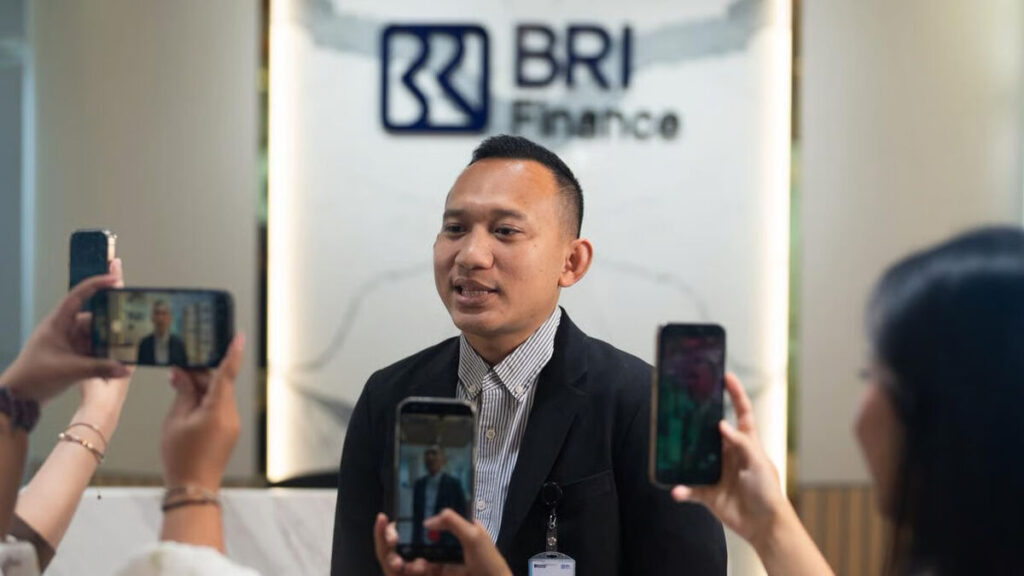
Jakarta, 14 April 2026 – PT BRI Multifinance Indonesia (“BRI Finance”) emphasizes its commitment to maintaining healthy and sustainable financing performance amidst the dynamics of the national automotive industry which is still facing pressure. In line with the weakening trend in demand for new car financing, the company continues to adjust its strategy in a measurable manner to continue capturing growth opportunities.
BRI Finance Corporate Secretary, Aditia Fakhri Ramadhani, said that there are two main factors influencing the current performance of new car financing, namely increasing consumer caution amidst economic uncertainty and vehicle price adjustments which have an impact on purchasing power and purchasing decisions.
“This condition encourages competition in the financing industry to become increasingly tight, so prudent risk management and adaptive strategies are needed,” said Dhani.
Responding to these challenges, BRI Finance implemented a more selective approach in distributing financing, including through competitive pricing adjustments based on customer risk profiles. Apart from that, the company also provides flexibility in financing schemes through more varied tenor options and adjustments to down payments (DP), in order to maintain affordability without sacrificing portfolio quality. This step is expected to maintain healthy financing growth while ensuring business sustainability in the long term.
Based on data from the Financial Services Authority (OJK), new car financing for the multi-finance industry recorded a contraction of 4.65% on an annual basis (year-on-year/YoY) to IDR 142.59 trillion. This decline was influenced by a number of factors, including adjustments in vehicle prices, a shift in preference to more efficient vehicles, and the public’s wait-and-see attitude in making purchasing decisions.
In terms of portfolio, new car financing is still the main contributor with a portion of 40.05%, while used car financing is 9.87% of the company’s total financing.
Furthermore, Dhani added that currently there is a shift in consumer preferences towards vehicles with lower total costs of ownership, such as the Low Cost Green Car (LCGC), as well as vehicles that are functional for family needs and daily activities, such as the Sport Utility Vehicle (SUV). Interest in electric vehicles continues to grow, even though they are not yet the dominant contributor to financing.
“This shift has also influenced the composition of vehicle financing in the market, both for new and used cars,” concluded Dhani.
This press release has also appeared on VRITIMES.
PakarPBN
A Private Blog Network (PBN) is a collection of websites that are controlled by a single individual or organization and used primarily to build backlinks to a “money site” in order to influence its ranking in search engines such as Google. The core idea behind a PBN is based on the importance of backlinks in Google’s ranking algorithm. Since Google views backlinks as signals of authority and trust, some website owners attempt to artificially create these signals through a controlled network of sites.
In a typical PBN setup, the owner acquires expired or aged domains that already have existing authority, backlinks, and history. These domains are rebuilt with new content and hosted separately, often using different IP addresses, hosting providers, themes, and ownership details to make them appear unrelated. Within the content published on these sites, links are strategically placed that point to the main website the owner wants to rank higher. By doing this, the owner attempts to pass link equity (also known as “link juice”) from the PBN sites to the target website.
The purpose of a PBN is to give the impression that the target website is naturally earning links from multiple independent sources. If done effectively, this can temporarily improve keyword rankings, increase organic visibility, and drive more traffic from search results.