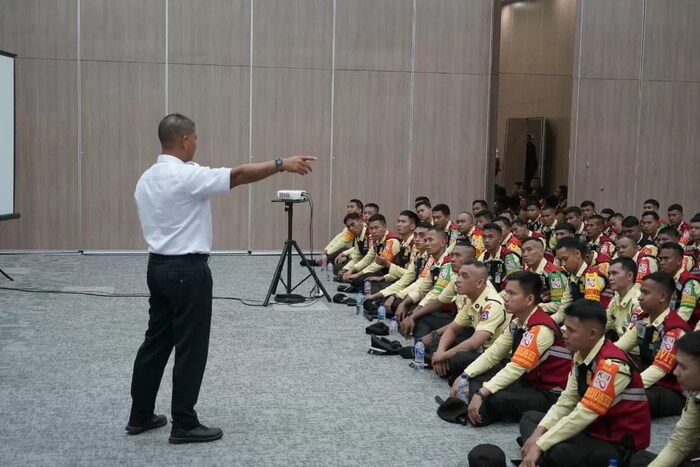
PT Kereta Api Indonesia (Persero) held coaching and evaluation activities for Jabodebek LRT security personnel at the Jabodebek LRT Office Auditorium. Involving RMU’s Security Outsourcing Operation staff, this evaluation focuses on discipline, implementation of field tasks, and service quality.
Currently, 123 security personnel are on standby at 18 stations as the front guard. Jabodebek LRT Manager of Public Relations, Radhitya Mardika, emphasized that this step is KAI’s ongoing commitment to ensure users feel safe and comfortable, not only in terms of travel operations but also security in the station environment.
PT Kereta Api Indonesia (Persero) continues to strengthen the security aspects of the Jabodebek LRT service by holding training and evaluation for security personnel to ensure safe, orderly and comfortable public transportation operations for the public.
This activity was carried out in the 2nd Floor Auditorium of the Jabodebek LRT Office involving the RMU Security Outsourcing Operation staff. Evaluation focuses on the implementation of security duties in the field, discipline, and improving service quality. Currently, the Jabodebek LRT is supported by (123) security personnel spread across 18 stations and operational areas, as the front guard in maintaining security and service order.
Manager of Public Relations for the Jabodebek LRT, Radhitya Mardika, said that this activity was part of ongoing efforts to maintain service quality from a safety perspective.
“Through regular coaching and evaluation, KAI ensures that all personnel have readiness, professionalism and the ability to provide a sense of security and comfort for Jabodebek LRT users,” he said.
Through this step, KAI is committed to continuing to improve overall service quality, not only in terms of travel operations, but also in ensuring that the station and train environment remains safe and conducive for the community.
This press release has also appeared on VRITIMES
PakarPBN
A Private Blog Network (PBN) is a collection of websites that are controlled by a single individual or organization and used primarily to build backlinks to a “money site” in order to influence its ranking in search engines such as Google. The core idea behind a PBN is based on the importance of backlinks in Google’s ranking algorithm. Since Google views backlinks as signals of authority and trust, some website owners attempt to artificially create these signals through a controlled network of sites.
In a typical PBN setup, the owner acquires expired or aged domains that already have existing authority, backlinks, and history. These domains are rebuilt with new content and hosted separately, often using different IP addresses, hosting providers, themes, and ownership details to make them appear unrelated. Within the content published on these sites, links are strategically placed that point to the main website the owner wants to rank higher. By doing this, the owner attempts to pass link equity (also known as “link juice”) from the PBN sites to the target website.
The purpose of a PBN is to give the impression that the target website is naturally earning links from multiple independent sources. If done effectively, this can temporarily improve keyword rankings, increase organic visibility, and drive more traffic from search results.
